install adobe digital editions to download ebooks from toronto public library to read on any device (laptop, tablet, smartphone)
http://www.adobe.com/ca/products/digital-editions.html

St. Simon Catholic Elementary School TCDSB 24 Strathburn Blvd. Mr. Nicola Di Croce, OCT Grade 7 Contact: stsimongr7@gmail.com or nicola.dicroce@tcdsb.org or
gr7

Monday, 14 January 2013
geography u4 environment cloze activity
U4 Geography Environment pg. 74-78 Big Ideas
The __________ is everything that is on, in, or surrounding
the __________.
Everyone takes in __________ and puts out __________
__________ into the air.
The environment is made up of 4 parts: the __________ (air),
the __________ (water), the __________ (Earth’s crust), and the __________ (all
living things).
The atmosphere allows us to __________; it shields us from
the direct rays of the __________; it supplies __________ to the land; it
provides __________ the nitrogen/carbon dioxide needed to grow.
The hydrosphere takes up almost __________ of the Earth’s
surface; it includes the __________, __________, __________, and the frozen
polar ice caps; our oceans supply most of the __________ that falls on land.
The lithosphere is the Earth’s crust or __________ and is up
to 50 __________ thick made up of __________ and soils that allow us to grow
crops and provides us with natural resources like __________, __________ and
__________.
The biosphere is the part of Earth where __________,
__________ and people live.
Air is made up of __________, oxygen and __________
__________.
The ozone layer high up in the stratosphere of our
atmosphere blocks out much of the harmful __________ (UV) light from the
__________ which can cause skin cancer.
Our ozone protection weakens when we use __________, __________ or
refrigerators because chemicals like
chlorine, fluorine and hydrocarbons are released into the atmosphere.
When we burn fossil fuels like __________ and __________ we release carbon dioxide into the atmosphere; this causes higher temperatures and changes to Earth systems – this called the __________ __________.


the breadwinner, chapter 1
|
chador
|
A piece of cloth
worn by women and girls to cover their hair and shoulders. Girls wear this
outside.
|
|
Taliban
|
Members of the
ruling party in Afghanistan at the time the novel was written.
|
|
Dari
|
One of two main
languages spoken in Afghanistan.
|
|
Pashtu
|
One of the two
main languages spoken in Afghanistan.
|
|
burqa
|
A long,
tent-like garment, which the Taliban have decreed women must wear whenever
they go outside. It covers them completely and even has a narrow mesh screen
over the eyes.
|
|
Soviets
|
The Soviet Union
before its break-up, including Russia and the other Communist countries.
|
|
nan
|
Afghan bread –
flat, sometimes long and sometimes round.
|
|
toshak
|
A narrow
mattress used in many Afghan homes instead of chairs or beds.
|
The
opening chapter of any novel has a variety of functions including:
· to
interest the reader and make them keep reading
· to
describe a character, a setting, or an event
· to set
the mood or tone for the rest of the book
After reading chapter 1 of the
Breadwinner, answer the following questions:
1. What are
your first impressions of Parvana and her family?
2. What is
your impression of daily life in Afghanistan?
3. What kind of mood/tone has the author set in chp.1?
science 3.2 corrections
3.2 Separating Mechanical Mixtures
Check Your Understanding
1. Methods of
separating the parts of a mechanical mixture include:
1. Sorting
2. Floating
3. Settling
4. Using
a magnet
5. Using
sieves & filters
6. Dissolving
7. Evaporation
can be used to separate salt from salty water
8. Chromatography
is used to separate the colors out of black ink
9. Distillation
is used to get pure water from sea water
2a. Metals in a scrap yard can be separated by sorting
and using a magnet.
2b. Paper clips can be separated from sand using a magnet
or a sieve.
2c. Gravel can be separated from water using a sieve.
3. Examples of
mixtures
·
Floating/Settling i.e. skimming fat from boiling
chicken to make a broth; cleaning a swimming pool skimming floating
insects/leafs; decanting wine from sediments at bottom of wine bottle.
·
Magnet i.e. searching for coins in sand
·
Sieving i.e. straining boiled food (peas,
corn, beans, pasta etc)
·
Filtration i.e. purifying water in city
treatment plant, making coffee/tea, separating sand from water
·
Dissolving i.e. using sugar, salt, butter,
honey in cooking
4.
·
picking veggies off a pizza (sorting)
·
organizing cutlery, laundry (sorting)
Separating mixture of snacking foods in bowl (chips,
crackers, preztels, cheese sticks etc)
Sorting would work because of the fairly large,
identifiable pieces;
Nothing is really floating to the top or settling at
the bottom;
Magnet would not attract anything;
Sieving with a colander, filtering with a small mesh
colander wouldn’t work because of the large pieces; nothing would really pass
through the holes whether large or fine.
Sunday, 13 January 2013
what's on the burner jan 14?
- Instrumental Music: Ms. K's work posted
- Novel: The Breadwinner Chapter 1
- Science: 3.2 Separating Mechanical Mixtures
- Geography: U4 Environment
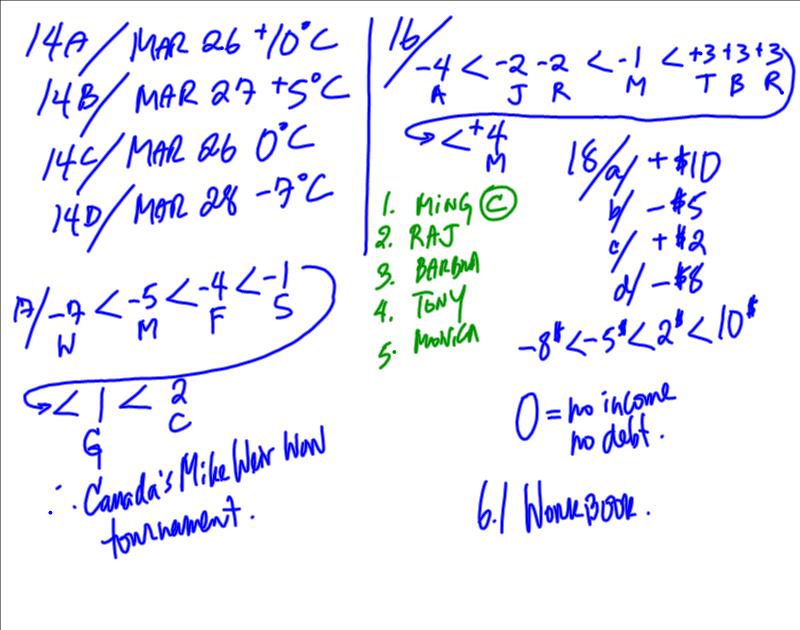
- Math: Integers 6.1 text & workbook corrections
Friday, 11 January 2013
weekend reminders & string art
Small Steps plot diagram prezi due Monday Jan 14th. You are to email me the link to your prezi. Compare it to my example so nothing is missing.
Mini science lab - separating mechanical mixture due Monday Jan 14th. email ms word file for me to print.
Monday we're going to correct 3.2 mechanical mixture checking your understanding and mix it up - have it completed (it's up on the blog Jan 7) Attempt to copy & paste into MS Word.
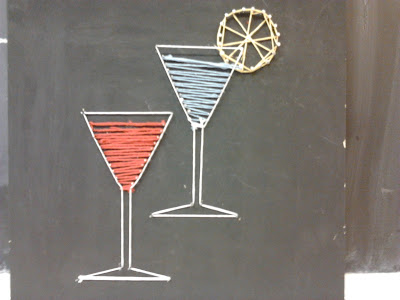
Great job on string art fun!!!




Mini science lab - separating mechanical mixture due Monday Jan 14th. email ms word file for me to print.
Monday we're going to correct 3.2 mechanical mixture checking your understanding and mix it up - have it completed (it's up on the blog Jan 7) Attempt to copy & paste into MS Word.
Great job on string art fun!!!


Thursday, 10 January 2013
Ski Trip Survey
Parents,
Kindly check out http://www.alpineslopes.ca
then
click on link below to complete survey question:
http://www.surveymonkey.com/s/RJM7LXF
Kindly check out http://www.alpineslopes.ca
then
click on link below to complete survey question:
http://www.surveymonkey.com/s/RJM7LXF
instrumental music work
Ch. 2 finish "all types of phones" due mon. jan. 14th
theory test thurs. jan. 17th rhythm & positions
playing test mon. jan. 21st line 86
theory test thurs. jan. 17th rhythm & positions
playing test mon. jan. 21st line 86
Subscribe to:
Posts (Atom)